The German Army at Ypres 1914 and The Battle for Flanders by Jack Sheldon
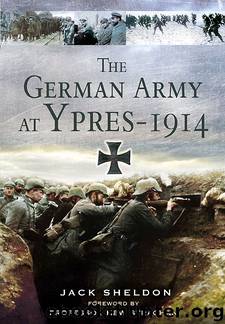
Author:Jack Sheldon [Sheldon, Jack]
Language: eng
Format: epub
Tags: Armed Services, Battles, Campaigns, World War I
Goodreads: 10208634
Publisher: Pen & Sword
Published: 2010-11-18T05:00:00+00:00
“Once patrols had established that the trenches, which the enemy had been occupying the previous evening, had apparently been evacuated, these companies, too, received the order to move forward at about 3.30 am. A dark night and fog facilitated the conduct [of the move] and, by 8.00 am, it was possible to report to the regiment that the battalion had moved forward to within two hundred metres of the enemy and dug in. As it became light it was possible clearly to make out two lines of enemy trenches, one behind the other and equipped with loopholes. Valiantly supported by the engineers, our men went to work with a will; the construction of communication trenches to the rear went on despite harassing fire.”
The garrison opposing the forthcoming attack was somewhat reduced and worn down compared with that which countered the original attacks. On 10 November, it comprised two battalions of Fusilier-Marins, one battalion from Senegal, whose solders had suffered particularly badly from the cold, wet conditions, and one Belgian battalion. All of these units were well below strength and the defending artillery was down to about thirty percent of its original strength. The odds had shifted significantly in favour of the attackers for the first time and, as dawn broke, the assaulting troops were able to lift their heads above the parapets of their trenches and consider the prospect of Diksmuide to their front with rather more equanimity than had been possible two weeks earlier. The fog was still too dense to enable them to see the outlines of the houses and other buildings to their front, but it provided useful cover as final preparations went ahead.
All concerned had worked hard to get ready but, as has been noted, for some the time was rather short, so maximum use was made of the limited visibility and although there was some desultory small arms fire, it was effectively unaimed and caused the attacking force no problems at all for the time being. At 10.45 am, Generalmajor von Seydewitz issued the confirmatory attack orders. The operation was to be conducted on a fairly narrow front to improve concentration of force. To the north of the town, 4th Ersatz Division was to launch an attack in strength to divert the attention and resources of the defenders, Reserve Jäger Battalion 15 was directed to bring pressure to bear from the northeast but, once again, the main effort was to be made by Reserve Infantry Regiment 201 right and Reserve Infantry Regiment 202 left. The right hand limit of this attack sector was from a point 400 metres north of the railway embankment south to the inter-regimental boundary, which ran along the Diksmuide – Kapelhoek road. To the south, the Reserve Infantry Regiment 202 frontage ran southwest, following the line of the railway to the cemetery about three hundred metres south of the town on the Woumen road and, due to the width involved, all three of its battalions were in line in the order north to south of 2nd, 3rd,and 1st.
Download
This site does not store any files on its server. We only index and link to content provided by other sites. Please contact the content providers to delete copyright contents if any and email us, we'll remove relevant links or contents immediately.
Personalized inhaled bacteriophage therapy for treatment of multidrug-resistant Pseudomonas aeruginosa in cystic fibrosis by unknow(178627)
CONSORT 2025 statement: updated guideline for reporting randomized trials by unknow(87159)
Critical evaluation of the ProfiLER-02 study design and outcomes by Vivek Subbiah & Razelle Kurzrock(86711)
Cardiac gene therapy makes a comeback by Oliver J. Müller & Susanne Hille & Anca Kliesow Remes(86475)
Whisky: Malt Whiskies of Scotland (Collins Little Books) by dominic roskrow(74443)
Unveiling the design rules for tunable emission in graphene quantum dots: A high-throughput TDDFT and machine learning perspective by Şener Özönder & Mustafa Coşkun Özdemir & Caner Ünlü(50895)
A yeast-based oral therapeutic delivers immune checkpoint inhibitors to reduce intestinal tumor burden by unknow(40265)
Covalent hitchhikers guide proteins to the nucleus by Alexander F. Russell & Madeline F. Currie & Champak Chatterjee(40217)
Meet the Authors: Christopher R. Mansfield and Emily R. Derbyshire by Christopher R. Mansfield & Emily R. Derbyshire(40099)
Alkaline-earth metals promote propane dehydrogenation with carbon dioxide through geometric effects: Altering the reaction pathway by unknow(32736)
Induced iron vacancies boosting FeOOH loaded on sustainable Fenton-like collagen fiber membrane for efficient removal of emerging contaminants by unknow(32511)
Efficient electric-field-assisted photochemical conversion of methane to n-propanol exclusively over penetrated TiO2Ti hollow fibers by Guanghui Feng(32456)
Bi2SiO5 nanosheets as piezo-photocatalyst for efficient degradation of 2,4-Dichlorophenol by Hangyu Shi & Yifu Li & Lishan Zhang & Guoguan Liu & Qian Zhang & Xuan Ru & Shan Zhong(32392)
A novel NDIPTA organic heterojunction photocatalyst with built-in electric field for efficient hydrogen production by Jiahui Yang & Baojun Ma & Yongfa Zhu(32367)
Enhanced conversion of methane to liquid-phase oxygenates via hollow ferrite nanotube@horseradish peroxidase based photoenzymatic catalysis by Jun Duan & Shiying Fan & Xinyong Li & Shaomin Liu(32333)
Ordered macroporous superstructure of defective carbon adorned with tiny cobalt sulfide for selective electrocatalytic hydrogenation of cinnamaldehyde by Xiao-Shi Yuan & Sheng-Hua Zhou & San-Mei Wang & Wenbo Wei & Xiaofang Li & Xin-Tao Wu & Qi-Long Zhu(32260)
What's Done in Darkness by Kayla Perrin(27152)
Topological analysis of non-conjugated ethylene oxide cored dendrimers decorated with tetraphenylethylene: Insights from degree-based descriptors using the polynomial approach by A Theertha Nair & D Antony Xavier & Annmaria Baby & S Akhila(26534)
Investigation of mechanical and self-healing properties of hydroxyl-terminated polybutadiene functionalized with 2-ureido-4-pyrimidinone by Mohsen Kazazi & Mehran Hayaty & Ali Mousaviazar(26461)
